

From Idea to Innovation: My First Hackathon Experience at UT Austin
- Nov 18, 2025
- 4 min read
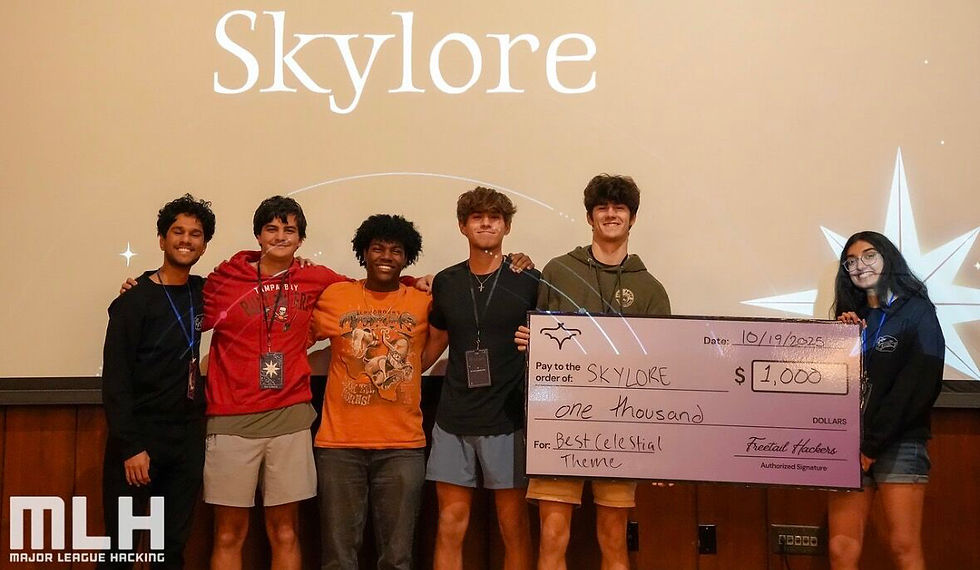
When I walked into my first hackathon as a freshman computer science student at UT Austin, I had no idea what to expect. Twenty-four hours later, I walked out on the winning team. But more importantly, I gained insight into what it takes to transform an idea into a working product under intense time pressure.
What Actually Happens at a Hackathon?
For those unfamiliar with hackathons, they're essentially sprint-style competitions where teams work together to build a functioning project within a strict timeframe. In our case, we had exactly 24 hours to conceive, design, and develop a working software prototype around a given theme of “celestial”.
The short time frame forces you to stick with your initial instincts and develop something real. You can't completely change your idea at the last minute because you don't have time. Unlike personal projects, where you can take your time with few consequences, hackathons force you to ship something real.
Design Thinking Under Pressure
When we first heard the competition theme “celestial”, our team didn't immediately start coding. We applied a design thinking approach, and it made all the difference.
Empathize & Define: We spent about 2 hours brainstorming because we figured that if we're not taking the right direction, it's just going to be a waste of time. We used a whiteboard to capture problems worth solving. One idea was gamifying banking education for young adults. But we kept asking ourselves: what problem do we actually care about solving?
Ideate: We wrote down the main topics and initial ideas, considering what was interesting about each. The most important thing was that we wanted to do something we actually thought was a cool idea, rather than something we thought the judges would just like, because we're spending 24 hours on it.
Prototype: We landed on an app that tracks constellations and uses that data to monitor light pollution. It allows users to take photos of constellations and identify them in the real world, turning environmental data collection into a fun, game-like experience. The user gets something rewarding from the photos themselves. Overall, our solution offered users an easy, rewarding way to gain information about the world around them.
Test: Throughout the 24 hours, we continuously tested our prototype. We learned the hard way that it's difficult to have four people working on the same thing at the same time. Initially, we all tried coding together, and we decided to divvy up the work. Sometimes one of us would work on a section and then hand it over to a teammate because they had a cool idea of how to code it up. This iterative approach - building, testing, adjusting - kept us moving forward.

Why Rapid Building Matters
One thing we really appreciate is that hackathons require you to actually build something rather than just pitch ideas. Anybody can brainstorm (even a three-year-old can come up with a creative idea!) But there's no way to see if it's actually realistic without adopting, at the very least, a prototype of what the idea could be. Without checking what type of implementation you have to use, there's no way to know if that would work.
Building forces you to confront the gap between concept and reality. It reveals where the challenging problems actually are and what trade-offs you need to make.
It was a lot of work, a lot of grinding in a short period of time, because we were trying to finish and running into bugs. I was awake for 21 hours, managing just a three-hour nap from 2 to 5 AM. But the constraint actually helped. It ends up making better products because you don't really have time to completely rechange what you're trying to do. You're forced to commit, execute, and iterate quickly, exactly like real-world product development.
What Companies Gain
Throughout the competition, we noticed several companies sponsoring the event. Afterwards, we discussed how those companies benefited from participating in a hackathon for college students. One of the biggest benefits for companies is the ability to see young talent solving the problems they face on a day-to-day basis. In addition to identifying talent, companies are likely inspired by the uqieu and creative solutions that are prototypes and may even want to bring those ideas back to their companies for fuller development. If companies see an idea that completely revolutionizes the way they were thinking about a problem, that could save months of otherwise wasted work by getting a different perspective.
What We Learned
Looking back on our first hackathon, we're struck by how much we learned in such a short time - not just about coding, but about design thinking, teamwork, and execution.
The design thinking framework kept us focused: understand the problem, brainstorm solutions, build a prototype, and test it. Those two hours we spent up front defining the right problem saved us from wasting 12 hours going in the wrong direction.
We learned that constraints can be liberating. The 24-hour deadline forced us to trust our instincts and commit rather than endlessly second-guess ourselves. And we learned that there's something uniquely valuable about building something real under pressure. It's one thing to learn algorithms in class. It's another to stay up for 21 hours straight, hitting bugs, solving problems, and ultimately shipping a working prototype that you can actually test with users.
Looking Forward
Winning our first hackathon as freshmen was incredible, but the real victory was discovering what we're capable of when the stakes are real and the clock is ticking. Design Thinking gave us a framework to move from problem to solution rapidly.
For any student considering their first hackathon, our advice is simple: do it. For companies looking to understand what the next generation of developers can do? Come to a hackathon. You'll see future engineers at their best, creative, collaborative, and determined to turn ideas into tested prototypes, no matter how little sleep they get!
That's the power of 24 hours, design thinking, and a great team.
Comments